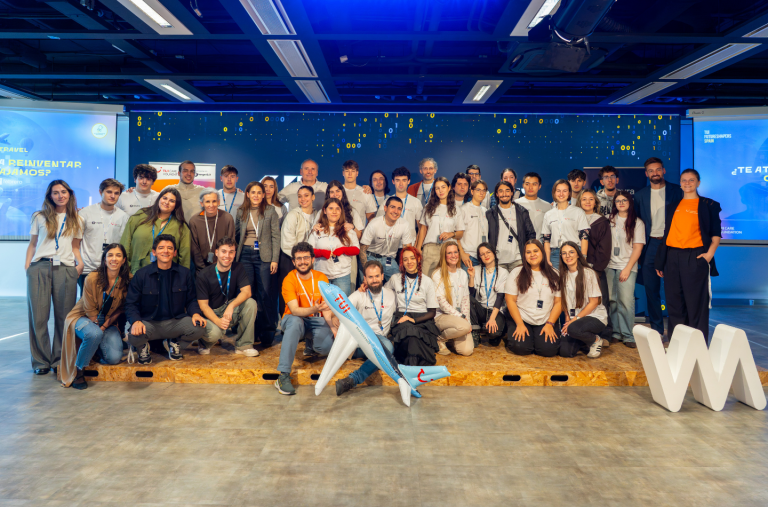
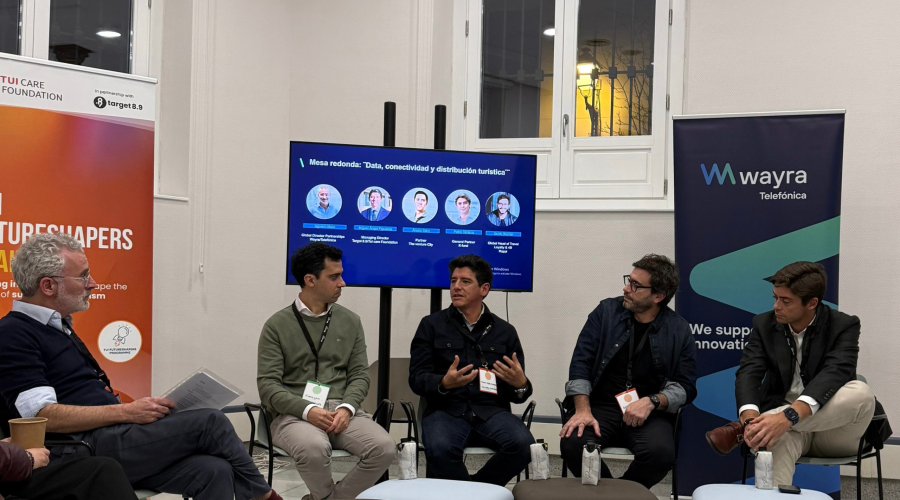
The tourism industry has always been a digital pioneer, but we have entered an era where Artificial Intelligence (AI) is no longer just an “optimisation layer”, it is a general-purpose technology redefining the entire value chain. At Target 8.9, we recently participated in a roundtable discussion with leaders from Kfund, TheVentureCity, Rappi, and Civitatis on “Data, Connectivity, and the Future of Smart Tourism Distribution” to analyse how these shifts impact destination governance and the resilience of the tourism system.
Spain recorded 96.8 million international tourists in 2025. This marked a new all-time high, up 3.2% from 93.8 million in 2024, according to official data from Spain’s National Statistics Institute (INE) via its FRONTUR survey. Overtourism is fundamentally a real‑time resource allocation failure: too many people, in too few places, at the wrong time, with value leaking out of the local economy. Global data confirms the pattern: satellite‑based analyses suggest around 80% of travellers visit just 10% of the world’s tourist destinations, creating intense spatial concentration.
Spain’s tourism sector faces a pivotal moment. While opportunities for growth abound, navigating the challenges of overtourism, sustainability, and maintaining competitiveness is crucial. Therefore, Target 8.9 is implementing the TUI Futureshapers Spain programme in partnership with Wayra, and funded by the TUI Care Foundation. This travel tech accelerator seeks to embrace innovative solutions, prioritising sustainable practices and diversifying offerings through digitalisation and sustainability.
Expectation Management and Seasonality (Desestacionalización)
AI‑based forecasting models, including deep learning with attention mechanisms and hybrid grey‑model/LSTM approaches, have proven significantly more accurate at predicting seasonal tourism demand than traditional time‑series models, especially in destinations with strong seasonality and non‑linear patterns. Accurate forecasts enable:
- Capacity management (beds, flights, staffing) in shoulder and low seasons
- Dynamic pricing that incentivises demand into off‑peak months
- Early identification of overload risks weeks in advance
Startups like Mindtrip, an AI‑powered travel platform, use conversational LLMs plus a massive database of over 10–11 million points of interest and tens of thousands of local guides. These solutions, along with other conversational front‑end AI innovations, create a three‑layer stack:
- Intent & inspiration: “Why and when do you want to travel?”
- Inventory & orchestration: “How can we assemble that trip given live capacity and constraints?”
- Distribution & assets: “Where do we have beds, seats, and local partners who can absorb incremental demand sustainably?”
This stack allows not only to sell what is full already, but to shift demand off‑peak and off‑centre when the AI is instructed to prioritise less saturated options.
Governing the AI Era of Tourism
Artificial Intelligence will not solve overtourism by itself, but it changes the rules of the game. What we are witnessing is not simply a new layer of automation, it is a structural shift in how demand is created, distributed, and managed. By embedding AI across the full tourism stack, it becomes a powerful governance tool to manage tourist flows using mobility data and to build resilience against systemic shocks through real-time monitoring.
For destinations like Spain, which operate at the frontier of global tourism demand with nearly 97 million international arrivals, the challenge is no longer growth alone, it is intelligent allocation. The opportunity lies in aligning AI capabilities with public-interest objectives, such as redistributing demand spatially and temporally, improving forecasting precision, and increasing local economic capture.
This is where collaboration becomes essential. Investors, startups, platforms, and foundations must work within a shared framework that recognises tourism as both a market and a system. We invite young innovators to join this mission at the upcoming TUI Futureshapers Spain Hackathon on 26 and 27 February, where university talent will co-create technological solutions to these real-world challenges.

The future of smart tourism will not be defined by how advanced our algorithms are, but by what objectives we encode into them. AI gives us the tools, governance determines the outcome.
The frontier is here. The question is whether we use it to optimise growth — or to redesign the system.