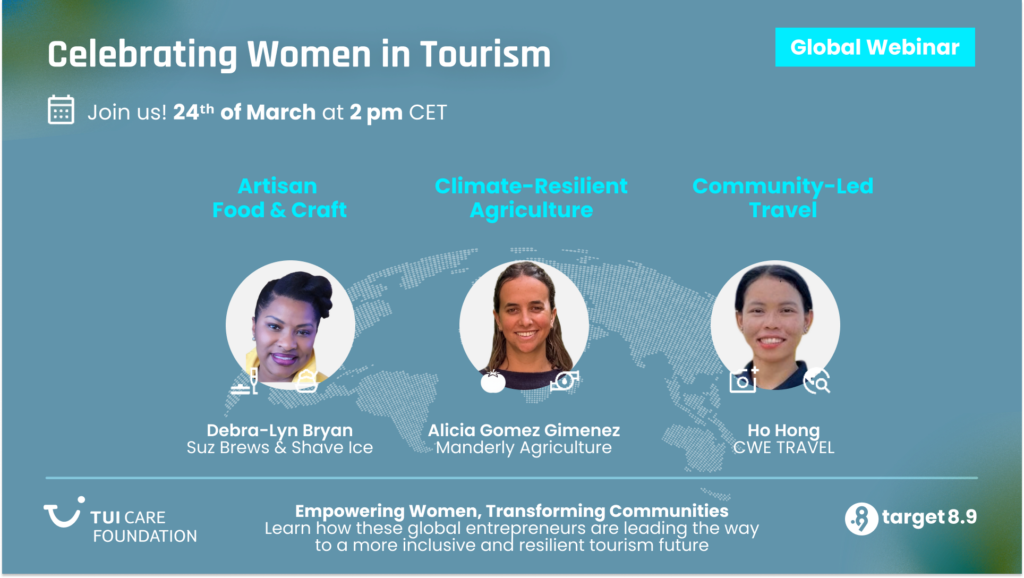
In the wake of International Women’s Day, we are keen to maintain the momentum by revisiting this year’s theme: “Give to Gain.” It is a fitting moment to celebrate the resilience and vision of female leaders who are transforming the tourism landscape. While women already hold vital roles and contribute significantly to the sector’s development, a gap remains in achieving truly equitable representation.
The data tells a compelling story: while women represent 54% of the global tourism workforce (Source: UNWTO 2019), women-led businesses continue to face a stark global funding gap, receiving less than 3% of venture capital (Source: World Bank 2017). Despite these hurdles, research indicates that when women lead, they reinvest up to 90% of their income back into their families and communities (Source: VanderBrug 2013). This creates a powerful multiplier effect for local development, perfectly embodying the “Give to Gain” philosophy.
To explore these themes, the TUI Care Foundation and Target 8.9 hosted a global webinar: “Global Impact, Local Roots — Celebrating Women in Tourism.” Held on 24 March, the session brought together three visionary leaders from Cape Verde, Jamaica, and Cambodia to discuss how they are using tourism as a tool for economic independence. During the opening discussion, the panelists shared the lived reality of navigating a male-dominated sphere, where mentorship and the courage to “be bold” are the essential keys to overcoming barriers to funding.
Disrupting Agriculture: Alicia Gomez Gimenez (Cape Verde)
Alicia Gomez Gimenez, CEO of Manderly Agriculture, joined the conversation to discuss her operations on the island of Sal. In a country that currently imports nearly 80% of its food (FAO 2020/21), Alicia is using high-tech hydroponics to turn arid land into 2,500 square metres of flourishing greenhouses. Supported by the TUI Field to Fork programme of the TUI Care Foundation and Target 8.9, her greenhouses supply fresh produce directly to global hotel chains like Hilton and Meliá. Her ultimate goal is to reduce Cape Verde’s dependence on food imports to the absolute minimum.
Alicia’s model is particularly disruptive because she maintains a 50% female workforce in a technical, innovation-led field where women have historically been underrepresented in the region. In an environment where the pressure on local resources is immense, Alicia is proving that tourism can nourish a community by using recycled hotel water for irrigation and training local women from scratch.
Digital Sovereignty: Debra-Lyn Bryan (Jamaica)
Representing the vibrant small business sector in the Caribbean, Debra-Lyn Bryan shared insights from her business, Suz Brews and Shave Ice. Based in the Falmouth Artisan Village—located by a pier that welcomes over 1 million cruise tourists annually (Source: Ministry of Tourism, Jamaica)—Debra faces the constant hurdle of attracting the attention of international visitors. She explained that while operations were her initial focus, the TUI Futureshapers Jamaica programme and Target 8.9 provided the “Digital Readiness” training necessary to build a modern marketing strategy.
Looking ahead to her upcoming “Investment Readiness” training, Debra is eager to master the tools needed to make high-level decisions for her business. For her, “Give to Gain” is a perspective of growth; she wants to ensure Suz Brews is structured to scale so that the impact can continue to reach her local team and the wider Falmouth community. She spoke about the unique nature of female leadership, noting that women naturally “think of everyone else like family,” ensuring that as her brand grows, the economic benefits remain firmly rooted at home.
Dignity Through Travel: Hong Ho (Cambodia)
In Cambodia, Hong Ho, CEO of CWE Travel, has pioneered a “From Women, for Women” model in Siem Reap. Her company offers immersive experiences—such as sunrise culinary walks and rice wine workshops—designed to uncover the country’s intangible heritage. As an “invited champion” for the upcoming TUI Futureshapers Cambodia initiative, Hong focuses on providing a path into the formal tourism economy for female guides and local youth.
Hong’s journey began as a challenge to prove that women could achieve economic independence despite local criticism. Her business prioritises education and dignity, ensuring that tourism acts as a social bridge rather than just a commercial transaction. During the webinar, she discussed the evolution of CWE Travel, noting that while they have focused heavily on the social aspects of their mission, the next step is to “become more profitable” to ensure their social impact is both sustainable and scalable.
A Global Force for Change
The insights shared during this webinar make one thing clear: when women lead in tourism, the impact reaches far beyond business—it strengthens communities, protects local cultures, and builds more resilient destinations. The stories from Alicia, Debra, and Hong remind us that with the right support, networks, and opportunities, female entrepreneurs are powerful drivers of sustainable development around the world.
By embracing the “Give to Gain” spirit, these entrepreneurs are not just running businesses; they are transforming the industry from the inside out. As we look towards the future of travel, it is clear that the most successful destinations will be those that empower local women to take the lead.